Hemming KNITS: 6 ways to beat those pesky puckers
I am really truly excited that so many of you are commenting to say that the KNITerviews have inspired you to get over yourself and try sewing with knits! I wanted to offer a few more posts about sewing with knits to help you S T R E T C H yourself (haha, GET IT??) and try it out. While I think it’s great to jump in and try new things, it’s realistic to expect a few bumps along the way. And while I strongly believe that mistakes are required if you want to learn, I also don’t want anyone to crash and burn! So I thought I’d offer a few tidbits of my own that might make sewing with knits easier for you.
I think one of the hardest things about sewing knits is puckery hems. Almost 100% of the time you are sewing with knits you are sewing garments. And there’s nothing worse than getting to the very last step (the hemming) and finding that your fabric just won’t hem without stretching and puckering. The problem is worst when sewing perpendicular to the grain, which is why hemming is often a source of frustration when it comes to sewing knits (but puckering can also happen anywhere: on the shoulder seams, on the arm curves, around the neck).So here are SIX ways that I’ve found to beat the puckery hem:
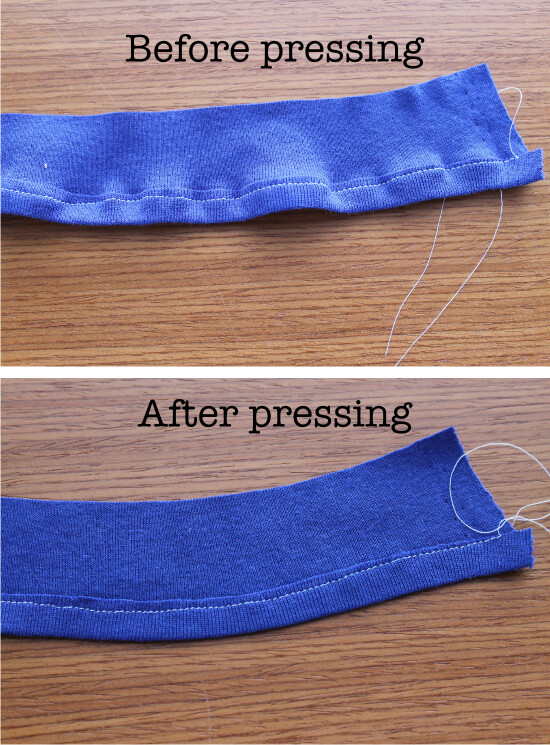
1. PRESS IT! aka The Iron Is Your Friend – this is a really good rule, for any type of sewing, really: when things look grim, press it before you toss it.
PROS: If you don’t own an iron, then you really shouldn’t be sewing. So that sounds really extreme, but I keep trying to find a better way to say it than that, and I really can’t. It’s like biking without a helmet. Or skydiving without a parachute (?). OK, maybe not quite like that…but you get my point. Pressing is REALLY REALLY REALLY important.
CONS: Pressing does not fix everything, just alotathings. For example, you can see in the photo (above) that while the iron may make the seam flatter, it can’t always un-stretch it. But it’s worth a try, right?
PROS: Easy to use on almost any sewing machine, makes a neat professional looking seam which stretches nicely due to the zig-zag on the back side.
CONS: You can’t sew with the wrong side on top because the bobbin side makes the zig-zag (this makes it a little trickier to sew a hem) and, depending on the type of knit you are using, you may get some skipped stitches. I found that using a different size needle helped, Katy suggests that you try moving your needle position over a bit, and Sascha mentions (in her KNITerview) that increasing the stitch length can also help. So a little trouble-shooting may be needed.
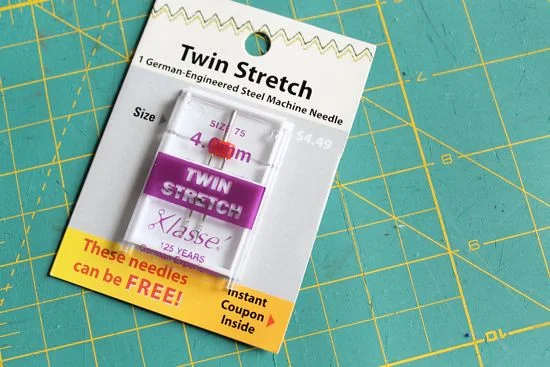
PROS: A little extra time at the iron, a lot less frustration at the machine.
CONS: Hard to find, a little pricey, doesn’t completely eliminate that “stretched-out” look, especially on super-stretchy knits
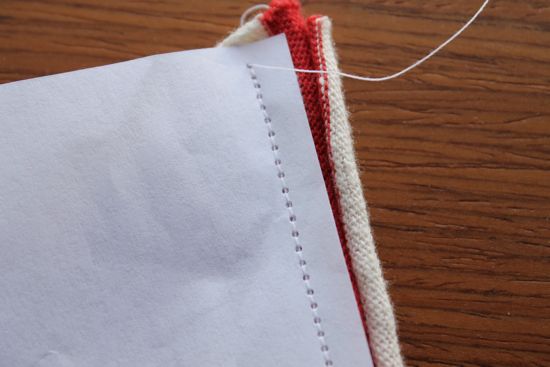
PROS: Everyone has paper, right?
CONS: Straight stitches break when stretched, so this might not be best for hems that see a ton of wear/stretching. I could see using it to hem a wide-leg jersey pant though! Also: thin paper doesn’t work as well as thick because it doesn’t tear away as easily and can get stuck under the stitches.
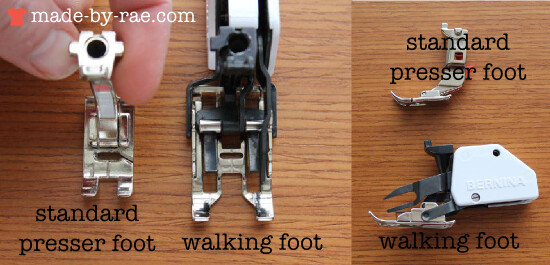
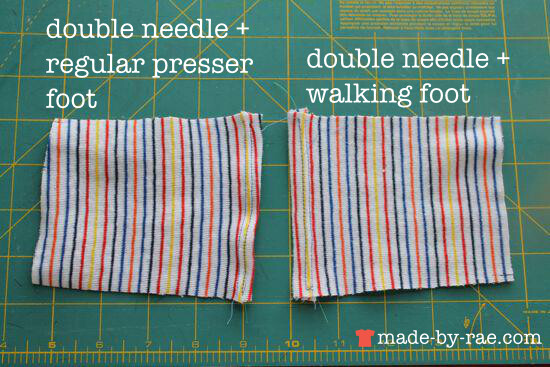
5. Walking foot - The walking foot adds less pressure to the fabric, which helps move it through the machine with less stretching. I’ve just made a little video demonstrating my walking foot that I’ll post soon where I make a complete fool of myself. Whee!
PROS: In combination with the double needle, this has become my current go-to way to hem knits. If the universal walking foot works on your machine, there could be just $10 between you and hemming happiness!
CONS: On my machine these are especially expensive (Bernina Activa 220). I had to save up for mine. No joke.
6: Add a cuff – It’s a cheat, really, but one of my favorite ways to finish the sleeve or waistband of a shirt or the hem of a knit pant is to add a folded cuff (aka a “waistband” if it’s on the hem of a shirt, but the concept is still the same). The idea is that you take a strip of fabric that’s slightly smaller than the edge you want to finish (the end of a sleeve, for example), sew the ends together and fold it in half. Then you place it on the outside of the garment and sew all three edges together (two from the cuff/waistband, one from the garment). Then you flip the cuff or waistband away from the garment so the seam is no longer visible. Voila, beautiful finish!
PROS: Easy finish with NO visible seams
CONS: Well you can’t put a cuff on everything.
58 Responses to Hemming KNITS: 6 ways to beat those pesky puckers
Leave a Reply Cancel reply
about Rae
Hi! I'm Rae, Head Boss Lady of Made By Rae Enterprises. I love to sew. This blog is a showcase for my crafty stuff.
More about me...
Email me!Sign up for my newsletter!
blog archive
spring tops!
add your photos to our Spring Top Sewalong Flickr group!
more info here
all MBR photo pools


I offer licenses for handmade sellers who would like to sell items made with my patterns on a small scale. To see all of the available licenses, visit the 


i want to go get a double needle right now!
Excellent!!! I have been sewing all summer with knits. My new best friend and my machine just wouldn’t do the job correctly. Now that I know about the double needle and walking foot technique, I am off to purchase both.
Thank you so much for the wonderful tips!
Fantastically useful. Thanks.
I can’t thank you enough for all of this info on sewing with knits! Lately that’s all I have been sewing so this is SO helpful.
I’d never heard of the stay tape… so that’s my “learn something new” for today.
I just acquired a walking foot about a year ago (for my 41-yr-old super-high shank machine, even – yay for eBay!), and it’s now my favorite tool! Wish I’d had one long before that!
A word of caution to the inexperienced about ironing… go easy and just ‘press’ gently, because ironing can stretch out knits, too!
Yes that’s definitely good advice – I try to just set the iron down on the fabric, and not move it back and forth too much
Can’t wait to try it out on this new skinny tee pattern! I guess I will need to get a double needle
Thanks for all the great information. It has been super useful. I havent sewn with knit since last summer but am now ready with some new information and I am excited to get started again.
I’ve been sewing knits for several years now and since I sew for 4 kiddos I made the investment in a coverstitcher. This was a good choice for me. I love being able to make a nice hem in minutes and don’t have to deal with any fiddly business.
Some other tips for knits are to use a longer stitch length and when hemming tight leggings or sleeves to stretch the knit as your sewing a little, so you don’t have to deal with popped stitches.
If you struggle with wonky neckbands I’d suggest taking a second look at your fabric. I like a knit (typically jersey) with a little lycra or el in it. The lycra helps the knit behave and “recover” back to where you want it.
Oh these posts have been so fantastic! I do sew w/ knits, but I’m hoping it will look soooo much better now! Have to try the double needle next.
I’m really enjoying all the knit tips. I am new and self- taught, but want to sew clothing my kids and I will actually wear (aka: not novelty cotton). Thanks so much!
I use my walking foot all the time, not just with knits. It is easy to use and makes a HUGE difference. I also use a double needle, but only sometimes because I find that I have trouble threading the needles no matter how many times I read the manual (Bernina), so I am looking forward to more from you on this
Also, I end up with extra bobbins of thread all the time, which I find kind of annoying. (I love knits so I am following this series eagerly. Thanks for doing it.)
Like Corie I also recently invested in a coverstitch machine. I had tried everything: zigzag, twin needle, walking foot etc but even when I finally got a good-looking finish, the stitches would break in just a couple of wears. It was so frustrating! Maybe it was partly because I only have old sewing machines to try on. The coverstitch machine was ludicrously expensive and really hard to justify, but I have three boys who love the t-shirts I make so I should eventually get my money’s worth. In about ten years, ha!
Another trick for hems is to use a quarter inch or half inch wide strip of fusible web (I like Steam a Seam) between the hem and the inside of the garment, fuse then stitch. It works really well with a double needle or with a very tiny zigzag.
My Singer machine does not allow space for two spools of thread, and therefore, I have not been able to use a double needle. Any suggestions?
Hi Susan: Two options, both involve using a spool and a bobbin on the top of your machine instead of two spools. First, if you use a spool and a bobbin, they might both fit together on your spool holder. Second, I just put the top bobbin on my bobbin winder on the top of my machine — it’s perched up on top so I can use that as my “second spool holder”. Does that make sense? – RAE
I had the same problem with my Singer. I got around it by winding some thread onto a bobbin and using the bobbin winder as a spool holder for it.
I place a short soda straw (approx. 5 in. long) over my spool holder. Then it will hold two spools of thread.
Can’t wait to see your videos! Will those be on this site or somewhere else?
Ok. This is life changing, seriously. The worst part of sewing with knits for me is wonky hems. I need to find some of that tape!
that tape is a revelation! thanks for sharing, Rae!
Susan, I haven’t been sewing that long, so I don’t want to give a stupid answer here, but perhaps what you need is a stand-alone spool holder? They have them at my JoAnn, but I couldn’t find a link online. I remembered Leah Day featured one recently, so I pulled this link for you. Hope it helps. And no one laugh at me if I misunderstood.
http://www.freemotionquilting.blogspot.com/2012/01/question-thursday-4.html
Or you could put the 2nd spool into a mug so it can spin away to its hearts content. Thats what I’d do. Cheaper!
Hi Rae,
When I try to send you an email it tries to load Microsoft Outlook which I no longer use. Could you email me so I can email you back?
Thanks!
Nancy
Thank you for doing this for us and our comfortable sewing (sucked and mangled knits are my bad dream as well).
Thank you! I’ve been sewing with knits for a while and love my double needle but now I’m convinced I need that walking foot.
Good stuff! And I totally get the Bernina expenses! I looked at a ruffler foot for mine and it was 3x what I would pay for a generic one. Still not sure I need/want/have to have it, though!
What great advice! I’ve always wanted to try sewing with a double needle & you inspired me to do so last night. I was hemming a great, big knit circle skirt & it turned out beautifully instead of being the disaster I feared it might be. Thanks!
I bought a walking foot this summer for my Brother machine and it was expensive ($90), but I have used it so much in just the last few months that it was totally worth it. I’ve only used my double needle once and I didn’t really like the outcome. I’m going to try it again though with a longer stitch length. I have loved this series. Thanks Rae!
That paper trick sounds neat! My machine always sucks the fabric into the bobbing case, especially if it is on the edge, or a thinner jersey. I’ll have to try it!
This is exactly the post that I needed! Thanks for posting this Rae! I have bookmarked this post so that I can read it over and over. I have been wanting to be able to make at least one knit item that doesn’t look stretched out. I will give it a try. I’ll be looking for a walking foot next.
Thanks! I finally got off my bum and made a t-shirt for my littlest boy, and it worked really well! I think that reading all of the tutorials and keeping all that advice in mind really helped (I’ve tried sewing with knits occasionally before with limited success). The T came out great (if a little small) and I’ll definately be making more. So easy! I blogged it, but with bad photos.
Now, to use that double needle I bought two years ago (its still in its packet
Thanks again – great tutorials.
Thanks for the tut- timely!!! I have had some success with paper and the walking foot- but thin knits really give me hard time- I have always just “cuffed” the item. (I make all my son’s PJ’s). I think it is time to be a big girl and graduate to the double needle. And look up here in Canada for the tape. Always enjoy your blog.
Thanks again.
[...] big factor in all of this is having a decent sewing machine that can handle knits. You may find this post on hemming knits helpful as well. I’m always happy to help as best I can by answering your questions via [...]
This is such a helpful post – thank you for writing it. When you were talking about the paper method and said that straight stitches break, it reminded that my mother taught me to set my machine to an ever-so-slight zig-zag for knits. It doesn’t really “read” as zig-zag but it allows some give–more than a straight stitch.
Yes that’s a great tip Vicki!
[...] ever tried to shorten a hem on a knit shirt only to come out with a wavy, puckered mess? Over at Made by Rae she will show you six ways to make a smooth knit hem. Rate this: Like this:LikeBe the first to [...]
I never thought about combining three together! Totally makes sense! I Usually do the cuff trick… even for the hem, lol! And I also used to have some of that stripey zig zag material in the one pic with the cuff. Ha! Thanks for the tips!
I love sewing with knits! Thanks for the great post.
I have a question for you–when I use a double needle, it often makes a “tunnel” that is very stubborn–it doesn’t even iron out all of the way. Any tips to avoid the tunnel?
Trisha, it is possible that the tunnel is because the bobbin thread tension is too tight.
Thank you so much for replying!
I’ve tried loosening the tension all the way down, and it’s still a problem. My next step will be to buy a walking foot to see if that helps alleviate the problem.
Trisha:
I notice that the “tunnel” is worse if I sew directly over the edge of the fabric (the raw edge that’s been turned up to hem). If I move my needle closer to the hem’s folded edge, it gets better. But it’s also possibly an issue of bobbin tension being too high, so you’d need to actually tighten the tension to fix it (not loosen).
I have the paper trick on my blog, too! Except I used it in place of stabilizer when sewing button holes onto really plush fabric! It’s such a great thing to keep those fabric fibers from pushing down into the bobbin! These kniterviews and all this knit information has really made me respect your blog so much! Thank you for the wealth of knowledge!
So I have to say, the knitereviews and this particular post has helped me tremendously with sewing with knits. I was scared to death that I would ruin whatever I was sewing. I have recently started making t-shirts for my grand baby. However, I am stuck on the rib knit collar. I have made two shirts so far and everything came out perfect except for the collar. I am guessing that I didn’t stretch it enough. How much is enough and how much is too much?
I am so happy to see this post. I love knits but sometimes I can’t get them to do what I want. These techniques are going to make a big diffrence in my knit sewing. Thank you.
OMG, what a great post! I’ve just started sewing with knits and I fell in love! Now all I want to do is to sew with knits. But when sewing my first project I came across few difficult points. I was not sure about my seam finishes and if my stays were correctly choses (in fact I used organza for the neckline and armholes stays, not sure if that’s the right alternative to the knit stay tape). After reading your tips, I am definitely more confident for my future projects! Thanks a bunch
[...] “Hemming KNITS: 6 Ways To Beat Those Pesky Puckers“ by Rae Hoekstra at Made By Rae. [...]
One more thing that can make a double-needle hem look a little more professional is this tip. You will notice that the fabric tunnels between the two lines of stitching. I recently read that to keep that from happening, you need to use a flat bottomed foot. Most feet leave a space on the underneath part of the foot to allow thick build up of thread for instance when you are sewing a buttonhole. I wonder if it would help to put some duct tape across the bottom of the walking foot to see if that helps to create a flatter hem also?
Thank you, Rae. I am short (and short-waisted), so modern t-shirts are always way too long. I’ve been flummoxed by my amateur attempts to hem these t-shirts, and certainly didn’t want to spend as much money as the t-shirts cost to have them professionally altered. Using two of your techniques above (double needle, walking foot) I was able to hem my shirts to my satisfaction!
I appreciate your knit, er, wit.
…
thanks so much for the tips
– sew helpful
!
For anyone who can’t find knit stay tape, try finding knit interfacing and cut it into strips. You can also control the width of the tape this way!
My next step with this little trick is going to be adapting Louise Cutting’s no-stitch hem technique (sew two pieces of interfacing together, right sides facing together, stitch 1/4″ from edge; place in hem and press) for use with a knit interfacing… then I won’t have to stitch a hem on knits at all!
Great Information……..I to have found using the walking foot makes sewing a lot easier. Not only on knits but when doing alterations and you need to take in a side seem (without taking out the original seam on ready made clothers) your fabric does not shift.
If it is possible on your sewing machine, reduce the presser foot pressure. That lets the fabric go under the presser foot without being stretched by the pressure between the foot the the feed dogs.
Sometimes a narrower twin needle eliminates the tunneling.
Thanks Janice!
[...] knit stay tape (see this post for more info) or fusible [...]
Great info! Thank you so much for posting. I’m still a very beginner sewer and I dont’ know how to do anything without getting frustrated, but I’ve just gotten my machine back from the cleaner (maintenace guy or whatever he’s called) and I’m up for mending a few of the kids’ clothes. I have 3 boys, so I love seeing all your BOY project. Yay!
Just re-read this post the other day while working on a jersey dress. These are such useful tips! Thanks for posting.